Competence booster for new event technology trainees
The new event technology trainees start their careers with a strong foundation. Three targeted basic courses give them a comprehensive overview of the most important technical areas of the industry. The topics of rigging & energy & lighting, audio technology as well as video and media technology form the basis for safe, competent and practical work. This means that the new colleagues are ideally prepared to play an active role in projects straight away.
Working safely at height, power supply and lighting - the basics of rigging, energy and lighting technology
The first basic course of the Competence Booster is dedicated to the essential basics of technical infrastructure in event technology: rigging, power supply and lighting design. These three areas form the backbone of every professional production – be it at trade fairs, concerts, corporate events or in permanent installations.
In the rigging area, trainees learn how to safely handle truss systems, motors and slings. They receive an introduction to physical principles such as load distribution, center of gravity calculation and static safety. The focus is also on legal and safety-related aspects – such as DGUV regulations, the importance of expert inspections and the correct documentation of superstructures. The aim is to raise awareness of the responsibility involved in working at height and to teach the basics of safe and compliant assembly.
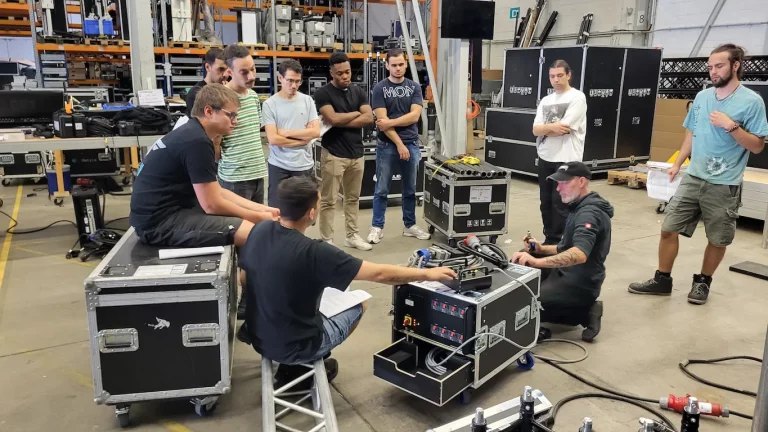
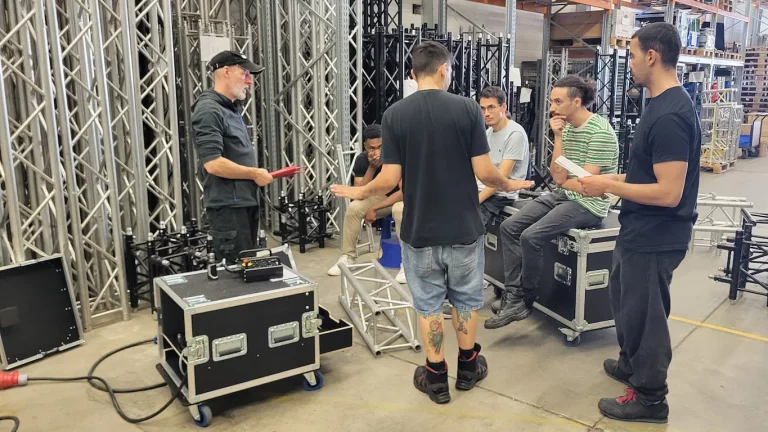
The second focus is on energy supply. Events require a stable and secure power infrastructure – often under challenging conditions. Trainees learn how to calculate power requirements, plan distribution systems and correctly implement fuses. Topics such as network types, protective measures, cable dimensioning and the use of RCDs are covered in a practical manner. The special features of mobile power supplies, such as generators or UPSs, are also covered.
The course is rounded off by the lighting technology section, which teaches not only technical but also design skills. Trainees are given an overview of different light sources – from halogen to LED and intelligent moving lights. They learn how to position, control and program light sources in order to create specific moods and effects. Lighting control panels and DMX technology are also used. In addition to the technology, the focus is also on creative applications: How does light influence perception? What role does color temperature play? And how is light used specifically to showcase brands, products or artists?
Practical exercises and real-life application examples enable trainees not only to understand the basics of rigging, energy and lighting, but also to put them into practice safely and creatively – a crucial step on the way to becoming an event technician.
From microphone to mixing console - technical understanding and practical knowledge in professional audio technology
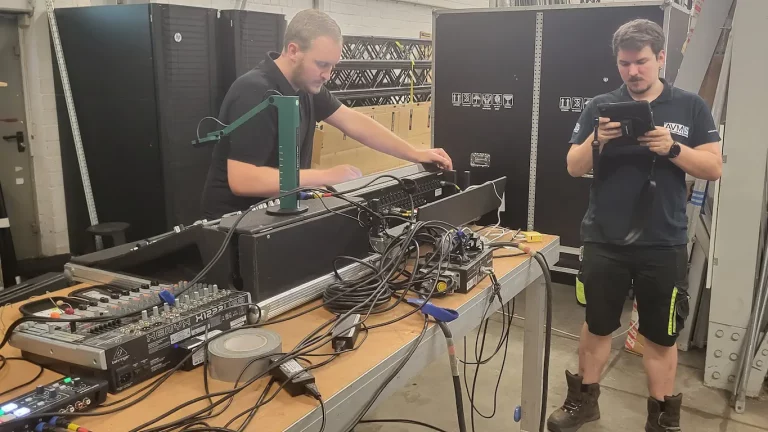
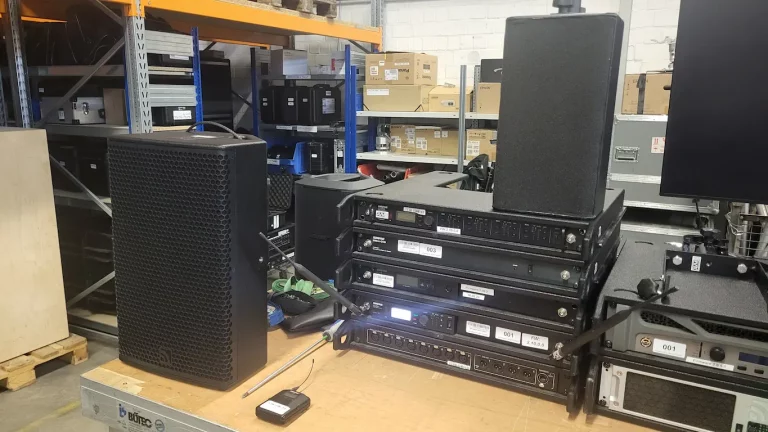
Audio technology plays a central role in the design of trade fair stands and events – be it for the clear communication of information, for emotional staging or to support interactive formats. As part of the competence booster, the trainees gain an in-depth insight into the world of professional sound reinforcement and audio planning.
The course begins with the basics of sound engineering: What types of microphones are there and how do they differ in their application? How does signal routing work, from microphones to mixing consoles to loudspeaker systems? Participants learn how analogue and digital audio signals are processed, what role equalizers, compressors and delays play and how to set up a stable and interference-free audio system.
A particular focus is on practical implementation at trade fair stands. Special requirements apply here: The technology must be compact, reliable and visually unobtrusive – but at the same time offer high speech intelligibility and sound quality. Trainees learn how to use small PA systems, active loudspeakers or discreet line arrays to provide optimum support for product presentations, lectures or interactive formats.
The challenges in noisy exhibition halls are also addressed: How do you deal with ambient noise? Which directional microphones or headsets are suitable for presentations? How can feedback be avoided and how can the acoustics of a stand be specifically improved?
Larger event formats are also covered – such as stage presentations, conferences or live acts. More complex systems are used here, such as digital mixing consoles, in-ear monitoring or wireless microphone technology. The trainees gain an insight into the planning and implementation of such setups, including frequency management, cabling and safety aspects.
The aim of the course is to combine a deep technical understanding with practical experience. The trainees should not only know how audio technology works, but also how they can use it in a targeted and creative way – for a convincing sound experience that enriches every event.
Image design and media integration - introduction to video and media technology for modern events
In the third module of the competence booster, trainees gain a comprehensive insight into the world of visual media, which is a central element of modern events today. The course begins with the basics of camera technology, image composition and signal management. Participants learn how different camera types are used, how image mixers work and how video content can be transmitted live or time-shifted to different media.
A particular focus is on signal processing: Which formats and resolutions are suitable for which applications? How are video signals reliably transmitted via SDI, HDMI or network protocols? The trainees learn how to prepare media content technically correctly and integrate it into existing systems – be it for a conference, a concert or a trade fair.
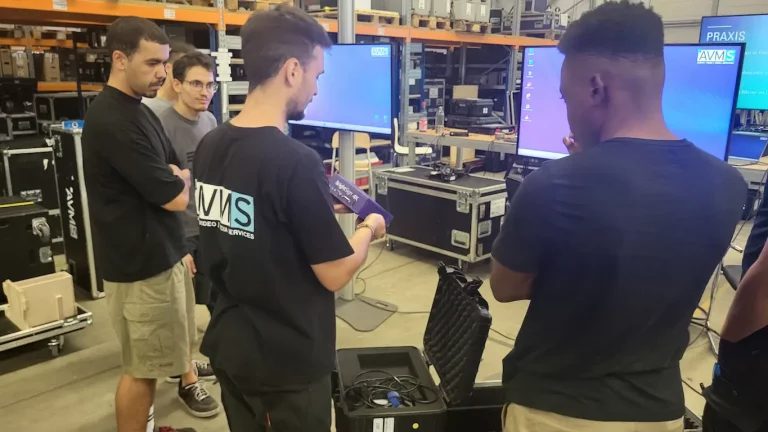
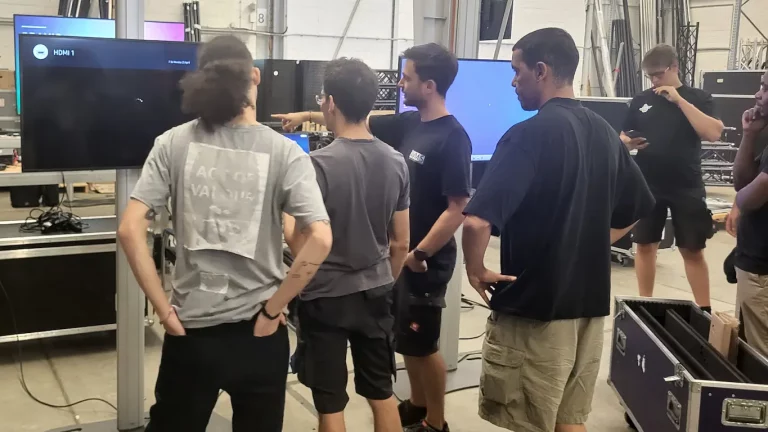
A highlight of the course is the introduction to LED technology, in particular the use of LED modules for trade fairs and major events. These modules have become an integral part of the event industry. They enable brilliant, large-scale displays of image and video content – both indoors and outdoors. The trainees learn how LED walls are set up, wired and controlled. It’s not just about the technology, but also about the creative design of content, the right resolution and adapting to different formats and requirements.
Through practical exercises with LED modules, participants learn how to present content in the best possible way and which safety aspects need to be taken into account during setup and operation. This enables them to integrate visual media effectively and professionally into events – a crucial area of expertise in today’s event technology.
You are currently viewing a placeholder content from Google Maps. To access the actual content, click the button below. Please note that doing so will share data with third-party providers.
More Information