Curved LED Screens in 2025: The Trade Show Guide
Anyone who still tries to impress visitors at an international trade show today with flat, strictly rectangular screens is tilting at architectural windmills. The audience’s viewing habits have changed: organic shapes, fluid movements, and immersive spatial concepts dominate modern booth design. This is exactly where our theme comes in: Curved LED Screens in 2025: The Trade Show Guide. Where rigid boundaries once restricted creative freedom, highly flexible diode carpets now shape genuine experiences. Yet behind the visual magic of a perfect wave or a floating 360-degree column lies tangible, uncompromising engineering. This article takes you on a journey through the physical feasibility, the pitfalls of structural engineering, and the secrets of pixel-precise synchronization—so that your next trade show installation not only looks great but also functions brilliantly from a technical standpoint.
Curved LED Walls in Practice: Mechanics & Feasibility
When we talk about bending light, we are essentially battling the physics of rigid circuit boards. The mechanical implementation of convex (outwardly curved) or concave (inwardly curved) shapes requires intelligent hardware solutions. The most common approach in professional trade show construction is the use of faceted standard cabinets. Here, conventional, rigid LED tiles are connected to one another using special angle connectors or integrated Curve-Lock systems. Through a fine grid—often in increments of -5 to +5 degrees per cabinet—a curve is created that, from a technical perspective, consists of many small polygons. From a certain viewing distance, these facets merge into a perfect, seamless curve as perceived by the human eye.
But what happens when the radius becomes extremely tight or the architecture requires a smooth S-curve? This is where faceted systems reach their mechanical limits. The solution lies in the use of flexible soft modules. With this technology, the LEDs are mounted on a flexible PCB (printed circuit board) that is protected by a rubberized mask. These modules are usually secured with strong magnets to a precisely prefabricated, curved substructure made of steel or aluminum. This makes it possible to create organic shapes that would simply be impossible with rigid cabinets.
The decision between faceted Curve-Locks and true soft modules is always a matter of balancing budget, required radius, and mechanical durability. While standard cabinets with a Curve mechanism are often faster to rig and more durable in daily tour use, soft modules offer the ultimate architectural freedom. To find the right setup for your specific spatial concept, it’s worth taking a closer look at the wide variety of LED modules and solutions available on today’s market for high-end installations.
5 Creative Formats for Modern Trade Show Installations
The move away from the 16:9 aspect ratio has ushered in an era of sculptural interior design. One of the most popular designs is the so-called “wave wall.” These gently curving S-shapes not only serve as giant digital screens but also function as an architectural wayfinding system that intuitively guides the flow of visitors toward the center of the exhibition booth. This concept is often complemented by organically shaped digital banners that replace rigid trade show panels and lend the booth a dynamic, wraparound aura. Especially with such flowing banners, the synergy between hardware and LED banners—along with their seamless media server playback —is absolutely crucial for the visual flow.
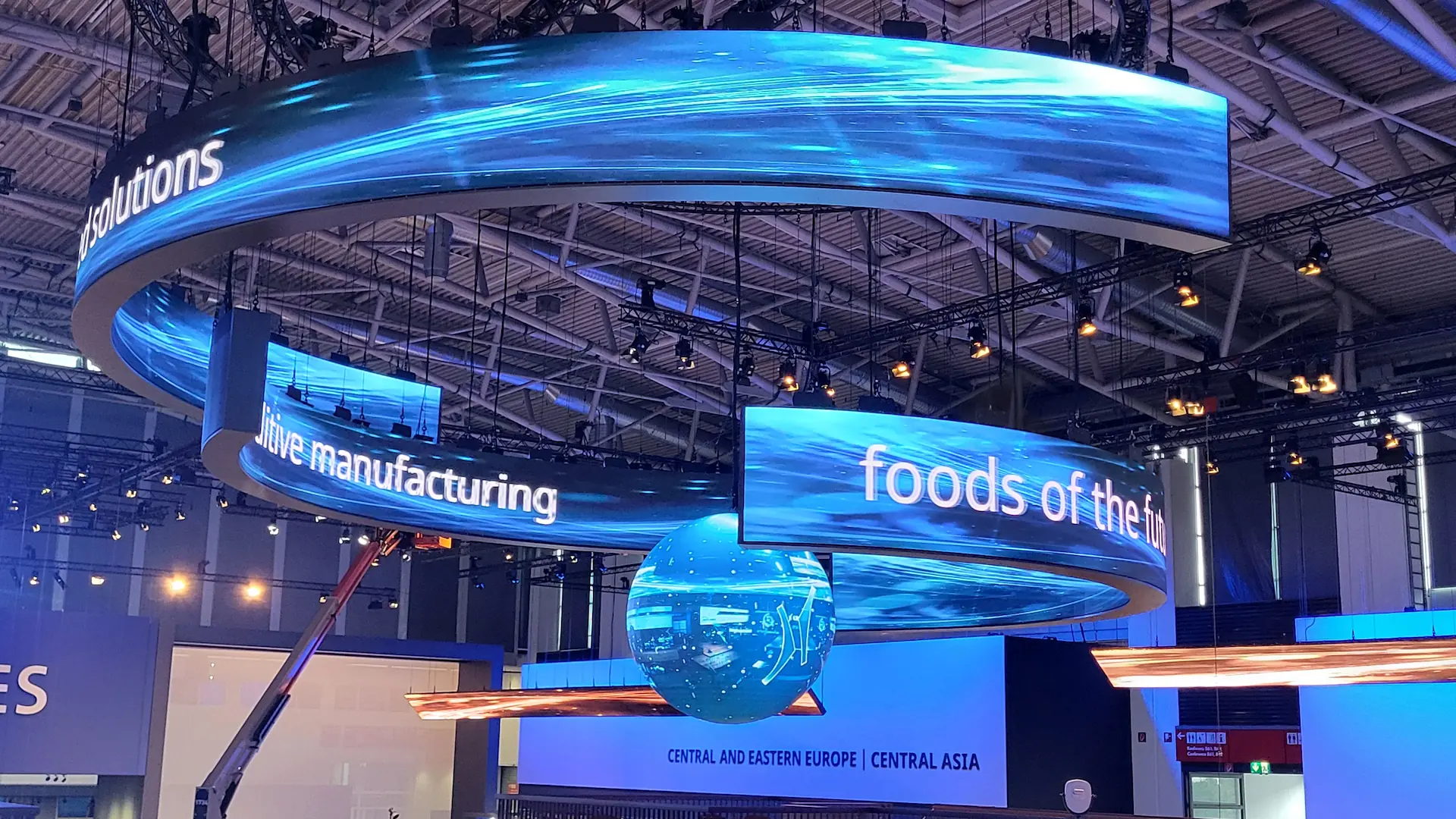
Another masterpiece of modern trade show architecture is the 360-degree column and ring, often referred to as a rotunda. A convex cylindrical installation in the center of a booth creates a visual beacon that is visible from every direction within the exhibition hall. Whether as a massive, floor-standing cylinder or a floating ring above visitors’ heads—these formats break away from traditional frontal presentation and force content creators to think in terms of endless loops and true spatial dimensions. An outstanding example of the space-defining effect of such formats is a professionally executed, impressive LED rotunda.
Ceiling cubes and immersive tunnel installations are no less spectacular. Seamless 90-degree exterior corners, created using special corner modules, form floating cubes that can be used for three-dimensional projections. Tunnel installations take the concept even further: Here, curved walls flow seamlessly into the ceiling and completely envelop the visitor. Such setups create an unparalleled sense of immersion but require the utmost precision in joint alignment to ensure that the optical illusion of the digital space is not ruined by gaping gaps.
Professional Design for Curved LED Walls: Structural Analysis & Radii
Selecting the correct pixel pitch (pixel spacing) for curved walls is a science in itself. The finer the pitch, the more sensitive the circuit boards are to mechanical stress. In addition, the viewer’s viewing angle constantly changes on curved surfaces. A radius that is too tight, combined with the wrong pixel pitch, can lead to an extreme moiré effect when filmed, as the grid pattern of the LEDs interferes with the grid of the camera sensor. Planners must therefore calculate precisely where the visitor will stand and what minimum radii the selected hardware allows without distorting the image or overloading the circuit boards.
When it comes to non-standard shapes, gravity is an impartial force. A curved LED wall has a completely different center of gravity than a flat wall. In suspended installations, the asymmetry of the curves creates torsional forces that act on the trussing. The rigging loads must be calculated in three dimensions to prevent the structure from tipping over or twisting dangerously. Even with floor-standing systems, the structural analysis is more complex: The substructure must safely transfer the wind loads (yes, even exhibition halls have drafts) and the immense dead weight of the modules through the legs into the hall floor.
Integration into traditional exhibition stand construction requires precision work down to the millimeter. When high-tech LEDs meet standard trade show grid systems (such as Octanorm) or custom carpentry, the interface determines success. Tolerances in trade show construction are often in the range of centimeters, whereas LED modules tolerate gap dimensions of less than one millimeter. Special adapter plates, adjustable mounts, and meticulous CAD planning in advance are essential for seamlessly and tension-free integration of the curved modules into the wood or aluminum architecture.
Content Mapping: Precise Feeding for Special Shapes
Once the hardware is in place, the digital magic begins—and so does the real challenge for video technology. Curved, circular, or wave-shaped LED installations don’t care about standard resolutions like Full HD or 4K. We’re talking about “Custom Canvas” here—that is, pixel canvases that can be defined with complete freedom. An S-curve, for example, can have an absurd resolution of 9,456 x 1,152 pixels. These massive, unconventional display surfaces must be split up, routed, and reassembled in perfect synchronization during signal processing—without causing frame drops or tearing.
The brains behind this pixel battle are powerful media servers. Systems such as Disguise, Dataton WATCHOUT, or Resolume Arena represent the state of the art for running such complex setups. They capture the produced content and distribute it via a variety of outputs to the LED controllers (e.g., from Novastar or Brompton). These controllers then map the signal with pinpoint accuracy to the individual cabinets. The media server ensures that the geometry of the curve is precisely replicated in the software, so that a ball rolling from left to right in the video retains its natural speed and shape on the physical curve.
It becomes particularly challenging with closed 3D shapes such as cylinders or rings. This is where UV mapping comes into play. Content creators must virtually “unwrap” the three-dimensional shape, much like peeling paper off a tin can. If a logo is displayed on a convex column, it must be deliberately pre-distorted (compressed) in the video file. Only then will it appear proportionally correct again to the viewer in space. This synergy of spatial imagination and pixel-precise mapping is what distinguishes a mediocre presentation from a breathtaking visual experience.
Mechanical Protection & Thermal Management in 360-Degree Systems
An often underestimated risk with curved installations is the mechanical exposure of the modules. Especially with convex (outwardly curved) walls and columns, the edges of the LED modules are exposed to the surrounding space. While the modules are protected side by side on a flat wall, the gaps at the front open slightly on convex curves. Here, the choice of LED encapsulation is essential. Traditional SMD LEDs (Surface Mounted Devices) are extremely susceptible to impact. For such special shapes, professionals are increasingly relying on GOB (Glue on Board) or COB (Chip on Board) technology. In these designs, the diodes are sealed with a layer of epoxy resin or adhesive, which not only makes them resistant to being bumped by trade show visitors but also makes cleaning them much easier.
An even more critical factor, one that is deeply rooted in physics, is thermal behavior. LEDs generate heat—and in enclosed 360-degree cylinders, rings, or thick, double-sided curved walls, this heat builds up inside. Since warm air rises, an enclosed LED cylinder quickly turns into a chimney without a flue. When diodes overheat, they rapidly lose brightness, color accuracy shifts toward red, and in the worst case, premature hardware failure threatens due to burned-out power supplies.
The solution lies in intelligent airflow management. When designing custom shapes, it is essential to incorporate ventilation slots, chimney effects in the substructure, or even active cooling systems (ultra-quiet fans). The challenge is to dissipate heat without generating disruptive background noise that interferes with conversations at the booth. Conducting thermal simulations in advance separates the wheat from the chaff and ensures that the installation will still shine in all its glory even on the sweltering fifth day of the trade show.
2025 Checklist: Effectively Implementing Curved LED Walls
The most important advice for planners is this: The LED wall is not an afterthought; it is the architecture. A successful implementation begins months before the trade show in CAD software. Trade show builders, riggers, and video technicians must all work from the same digital 3D model. Only by reconciling the structural integrity of the mounting points, the radii of the available LED modules, and the tolerances of the wooden substructure early on can you avoid unpleasant surprises during on-site setup. Every carelessly planned centimeter will come back to haunt you later in the form of visible black gaps in the image.
In parallel with the hardware, the content pipeline must be started extremely early. Motion designers cannot work based on vague estimates. From day one, they need an exact pixel map (the so-called “canvas template”) from the video engineering department. This template not only specifies the absurdly high total resolution but also marks “safe zones,” fold lines, and the physical radii of the wall. The more complex the curve, the more time must be allocated for pre-rendering and test runs on the media server.
Ultimately, the success of the project hinges on choosing the right technology partner. You don’t need a company that just moves boxes around; you need specialists who understand mechanics, IT, video signal processing, and trade show construction as a holistic ecosystem. A look at the extensive list of references for complex LED installations will help you identify service providers who have already successfully mastered the transition from theory to millimeter-precise practice and will bring your project to life with technical finesse and a cool head.
Curved LED Walls 2025: The trade show guide clearly shows that the future of live communication is fluid, immersive, and three-dimensional. The shift away from rigid rectangles opens up unprecedented creative freedom for brands to draw visitors into their worlds. At the same time, this freedom requires the highest level of engineering precision—from static calculations of rig loads to thermal management inside the modules, right down to pixel-precise UV mapping on high-performance media servers. Those who take these technical challenges seriously and collaborate with experienced partners early in the planning process will not only stand out at the next trade show but will also leave a lasting impression. The technology is ready for your boldest visions—now it’s up to you to reshape the space.
